

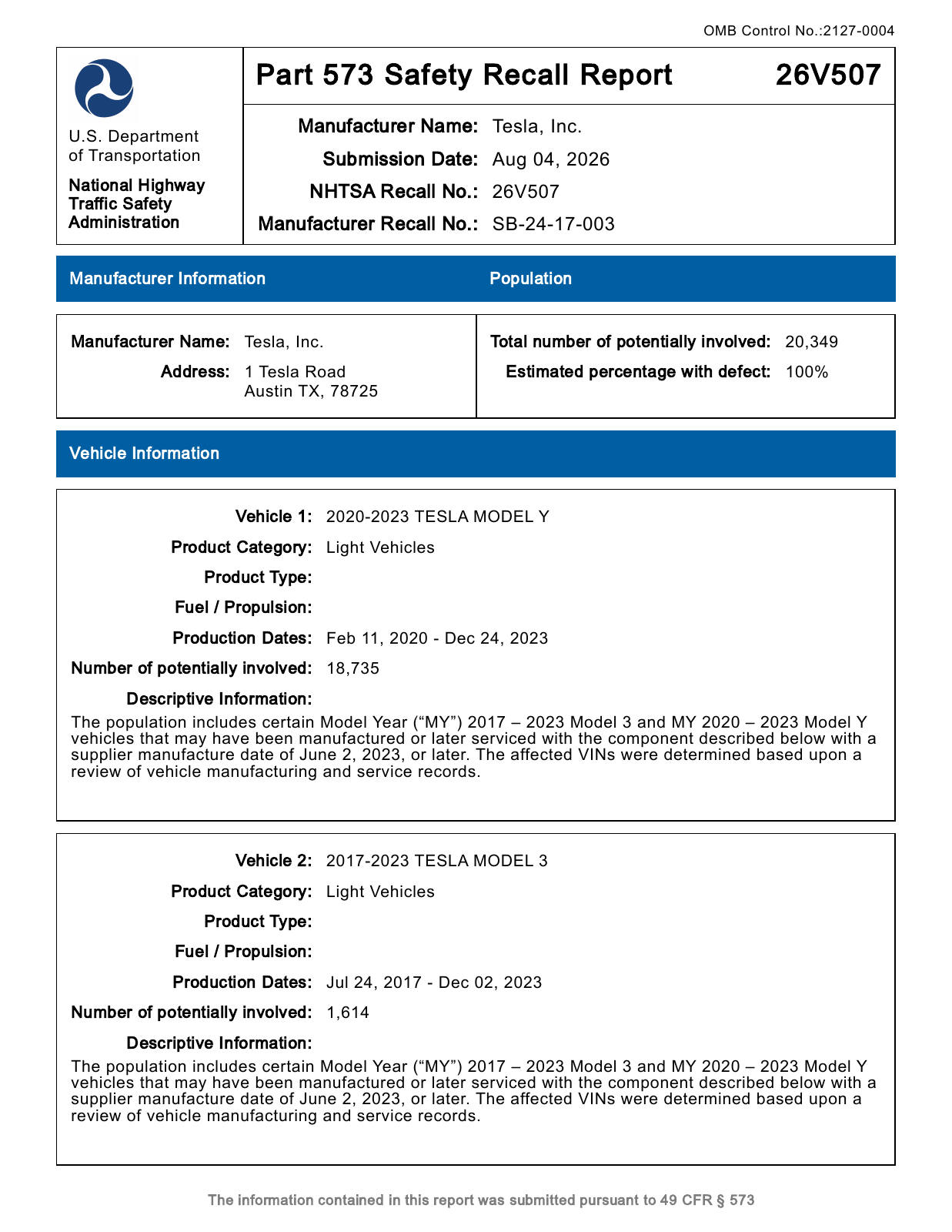
Tesla headlight recall 26V507 concerns 20,349 Model 3 and Model Y vehicles in the United States. Tesla’s report submitted to NHTSA on 4 August 2026 describes a low-beam noncompliance. The market needs to be clear from the outset: this US campaign is not a recall announced for every Italian vehicle.
Archive coverage published on 23 October 2026. The editorial date of 11 August reconstructs the story using the original August report; later developments are not included in this historical version.
In this article
Tesla headlight recall: the vehicles identified in the report
The document distinguishes two groups: 18,735 Model Y vehicles from model years 2020–2023 and 1,614 Model 3 vehicles from model years 2017–2023. It does not mean every car from those years is included: the specific population identified by the manufacturer matters.
The selection covers vehicles built or subsequently repaired with certain headlight assemblies, with supplier production dates from 2 June 2023. Affected VINs were identified through manufacturing and service records.
The issue concerns light distribution
The report identifies intensity exceeding the permitted maximum in certain upper zones of the low-beam pattern under US standard FMVSS 108. Its risk description mentions potentially reduced visibility for the driver and other road users, increasing crash risk.
It is therefore incorrect to summarise the case as stronger light automatically being better. Where the light falls also matters: illuminating the road and limiting light in other directions are needs to consider together. A value outside test limits describes a different issue from the driver’s subjective impression of seeing well.
The remedy was still in development in August
In the original version of the report, the remedy was still under development. Owner notification was planned for 15 September 2026. Tesla’s campaign reference is SB-24-17-003.
This documentary snapshot does not support promises of replacement with matrix headlights, a particular part or a software fix. These are three different possibilities and should not be treated as an intervention already defined in the August text. A planned notification date also does not, by itself, prove every recipient actually received the letter that day.
The US Tesla headlight recall: the distinction with Italy
The model name alone cannot automatically transfer a campaign from one market to another. This historical account concerns US file 26V507: it does not document extension of the same action to Model 3 and Model Y vehicles sold in Italy.
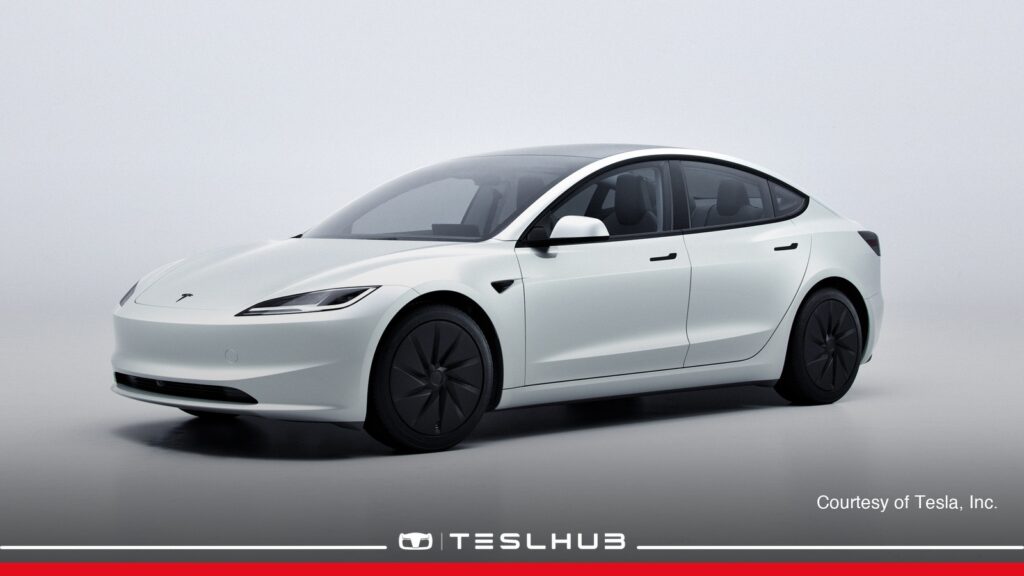
Interpreting recall news correctly requires separating the commercial model, model year and individual vehicle. Two cars with similar names can have different manufacturing or service histories. An archive photograph helps identify a vehicle generation but does not certify that the example shown has the affected component.
How to interpret this archive account
This article preserves the picture known in August 2026. It is not a check of an individual car’s current status and provides no instructions for adjusting or dismantling headlights. An individual assessment requires the VIN and the manufacturer’s current guidance for that actual vehicle.
The original document is useful precisely because it separates the affected vehicle count, noncompliance and remedy status. Keeping these elements distinct avoids both extending concern to every Tesla and presenting a situation as already resolved when the initial report still required a defined solution.
Primary source: NHTSA, Part 573 Safety Recall Report 26V507, submitted on 4 August 2026. Cover: pre-refresh Model Y, archive photograph from Teslhub’s library; it does not identify a recalled vehicle.
To distinguish this generation from its successor, explore our Tesla news and analysis archive. Community updates are on the official Teslhub Telegram channel.
Alessandro Marmaglio — Teslhub




Let’s discuss it
Experiences, questions and perspectives from the Teslhub community.
Please keep the discussion respectful. Members’ comments are moderated before publication.
Start the conversation. Leave the first comment.