
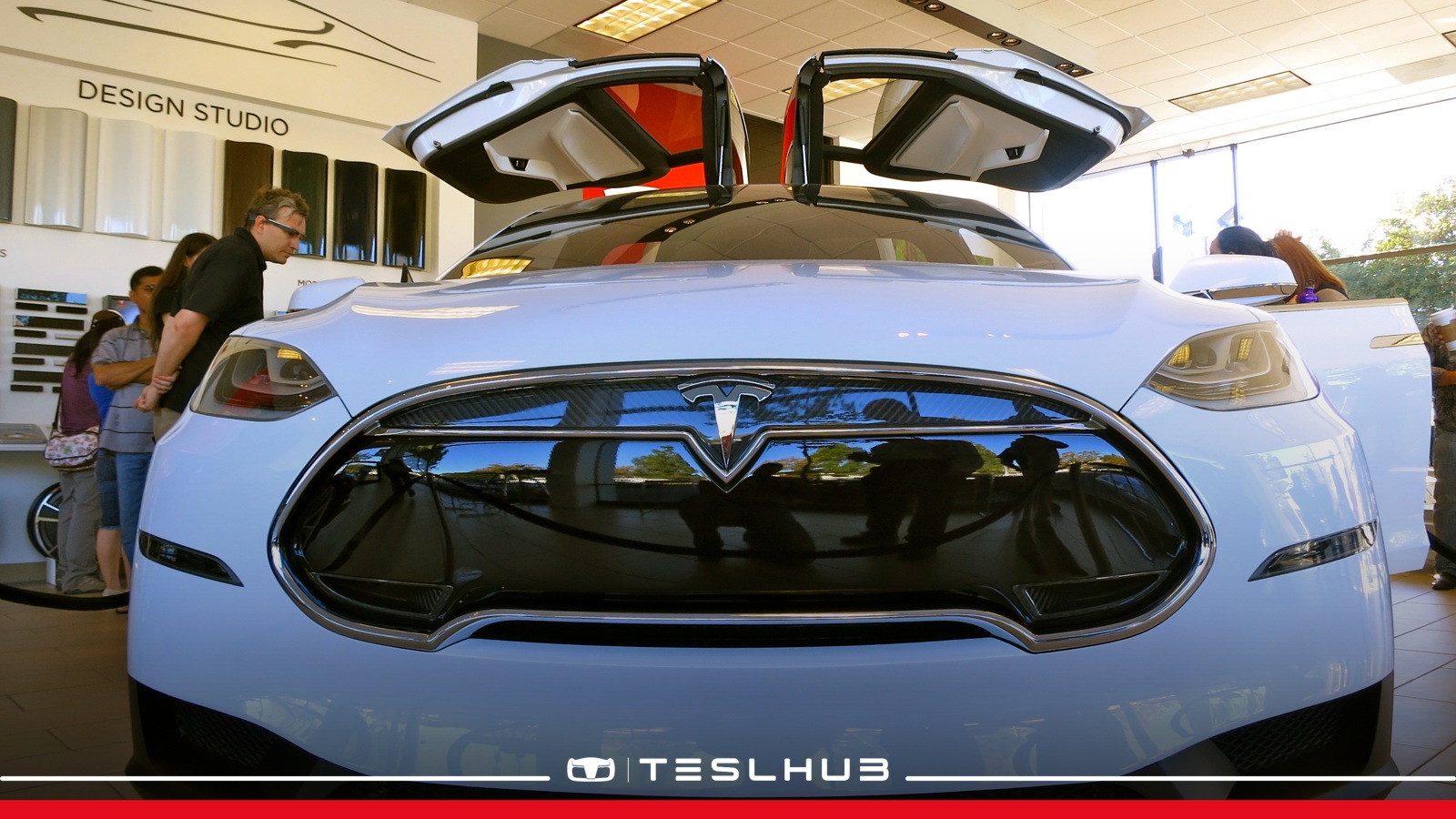
9 February 2012, Hawthorne, California. This archive article was prepared in October 2026. The Model X prototype presentation preceded the first deliveries by more than three years. Features announced then should be read as part of a design still under development.
The rear doors rose towards the roof, making access to the cabin the presentation’s most recognisable moment. The 2012 Model X centred on a practical question: how could electric propulsion be brought to a family vehicle carrying more passengers and serving different needs from a sports car or saloon?
Tesla showed it at its Hawthorne design centre in the Los Angeles area, before Model S deliveries had begun. This was not the commercial launch of the SUV that would reach customers in 2015; it previewed another path built around the same technical platform.
Model X: a different idea of an electric crossover
Falcon Wing doors were the design’s signature. Tesla proposed combining SUV characteristics with MPV practicality, with dual-motor all-wheel drive planned as an option. The doors’ movement was part of the functional proposal as well as a dramatic visual feature.
Building on the Model S architecture had an industrial rationale: expanding the range while sharing some of the work already completed. Two body styles aimed at different needs could emerge from a common base without being the same product. In February 2012, however, that possibility had yet to become a production line capable of building the new model.
Initial interest was not yet a delivery
The day after the presentation, Tesla recorded more than 500 reservation requests. Reserving required a minimum refundable deposit of $5,000. These are historical figures describing commercial interest in the project, not 500 delivered vehicles or a production result.
Performance expectations also belonged to that phase. Tesla projected a 0–60 mph time of 4.4 seconds for the Dual Motor version. This was an announced forecast for a vehicle under development, not our road test or a figure to be reported as 0–100 km/h.
The schedule changed during development
The initial plan targeted production towards the end of 2013 and significant deliveries in early 2014. The subsequent timeline was different. In its third-quarter 2014 report, Tesla was still discussing Alpha prototype testing and building the first Beta vehicles, allowing more time for validation.
The new delivery target became the third quarter of 2015. Completing engineering, preparing suppliers and passing tests remained necessary steps. This is an important distinction: having a prototype to show is not the same as having an industrial product ready.
The first customer deliveries eventually began in September 2015. The 2012 debut and the 2015 commercial start are therefore two different moments, both useful for understanding Model X. Between them lies development, with revised targets and checks still to complete.
A visible promise before the final product
Revisiting that prototype helps distinguish a project’s identity from a car’s final specifications. Falcon Wing doors already made the idea recognisable, while timings and configurations were still evolving. That is the presentation’s historical value: showing an ambition to expand electric mobility before the manufacturing operation was ready to do it at scale.
Sources: Tesla’s release of 10 February 2012 about the previous evening’s event; Tesla’s letter of 15 February 2012; Tesla’s third-quarter 2014 Form 10-Q, page 25; Tesla’s third-quarter 2015 Form 10-Q.
Cover: original photograph by Steve Jurvetson, Tesla Model X Design, 13 October 2013, CC BY 2.0. Archive image of the concept displayed in Palo Alto, not the evening of 9 February 2012 or the production version. Adaptation: cropping and overlaying the complete original Teslhub PNG. No endorsement of Teslhub by the author is implied.



Let’s discuss it
Experiences, questions and perspectives from the Teslhub community.
Please keep the discussion respectful. Members’ comments are moderated before publication.
Start the conversation. Leave the first comment.