
News from 29 January 2025. This archive article was prepared in October 2026 and explores the Cybertruck’s electrical design choices described alongside Tesla’s 2024 results.
The Cybertruck is instantly recognisable by its bodywork, but some of its most interesting differences are hidden. Its 48-volt system, 800-volt traction battery and Etherloop network address different problems: supplying auxiliary systems, moving the vehicle and connecting controllers. Grouping them under a single label would miss the point of the design.
Cybertruck and 48 volts: less current for the same power
The 48-volt auxiliary network powers functions separate from propulsion. Its lithium-ion auxiliary battery supports systems such as windows, doors and the touchscreen when the high-voltage battery is unavailable. It also provides redundant power for critical functions, including power steering.
The electrical benefit can be understood through an idealised example, without treating it as the car’s actual consumption. A 240-watt device requires 20 amps at 12 volts, or 5 amps at 48 volts. Power stays the same while current falls to a quarter. This follows the relationship power = voltage × current.
Resistive losses in cables depend on the square of the current. With conductor resistance unchanged, a quarter of the current means one-sixteenth of the losses. This is a circuit comparison, not sixteen times more driving range. Designers can also choose lighter wiring, finding a different balance between weight, cost and losses.
800 volts and Etherloop are not the same thing
For propulsion, the Cybertruck uses an 800-volt battery system. Higher voltage reduces the current required to transfer a given amount of power. The principle is similar to the one above, but it applies to a different part of the car. It does not mean every circuit in the pickup operates at 800 volts.
Etherloop concerns communication instead. The Ethernet network and distributed controllers reduce connections running across the vehicle. Tesla reported eliminating 70% of cross-car wires. That figure concerns a specific group of connections, not the weight of all wiring or 70% of electrical components.
Power and communication are therefore complementary layers. One carries energy where it is needed; the other carries commands and information. Reducing connections can simplify the architecture, but it does not remove the need to power devices and manage essential functions with appropriate redundancy.
A design choice, not a downloadable update
These solutions involve batteries, electronics, connectors and wiring. They are therefore not equivalent to a software feature transferable to an older Tesla through an update. Even the label “low voltage” needs context: a 48-volt system does not make the same accessories or connections suitable as those used in a conventional 12-volt system.
Part of the Cybertruck’s historical significance lies in this attempt to rethink less visible parts of the car. Beyond its unusual appearance, it is a design in which energy and data management become tools for reducing complexity and weight. The outcome for an individual vehicle depends on the combined design choices, not on voltage considered alone.
Sources: Tesla’s Q4 and full-year 2024 results, 29 January 2025, Cybertruck technology table; Tesla, Cybertruck electric vehicle components. The idealised numerical example is calculated using P = V × I and losses = I² × R, with resistance unchanged.
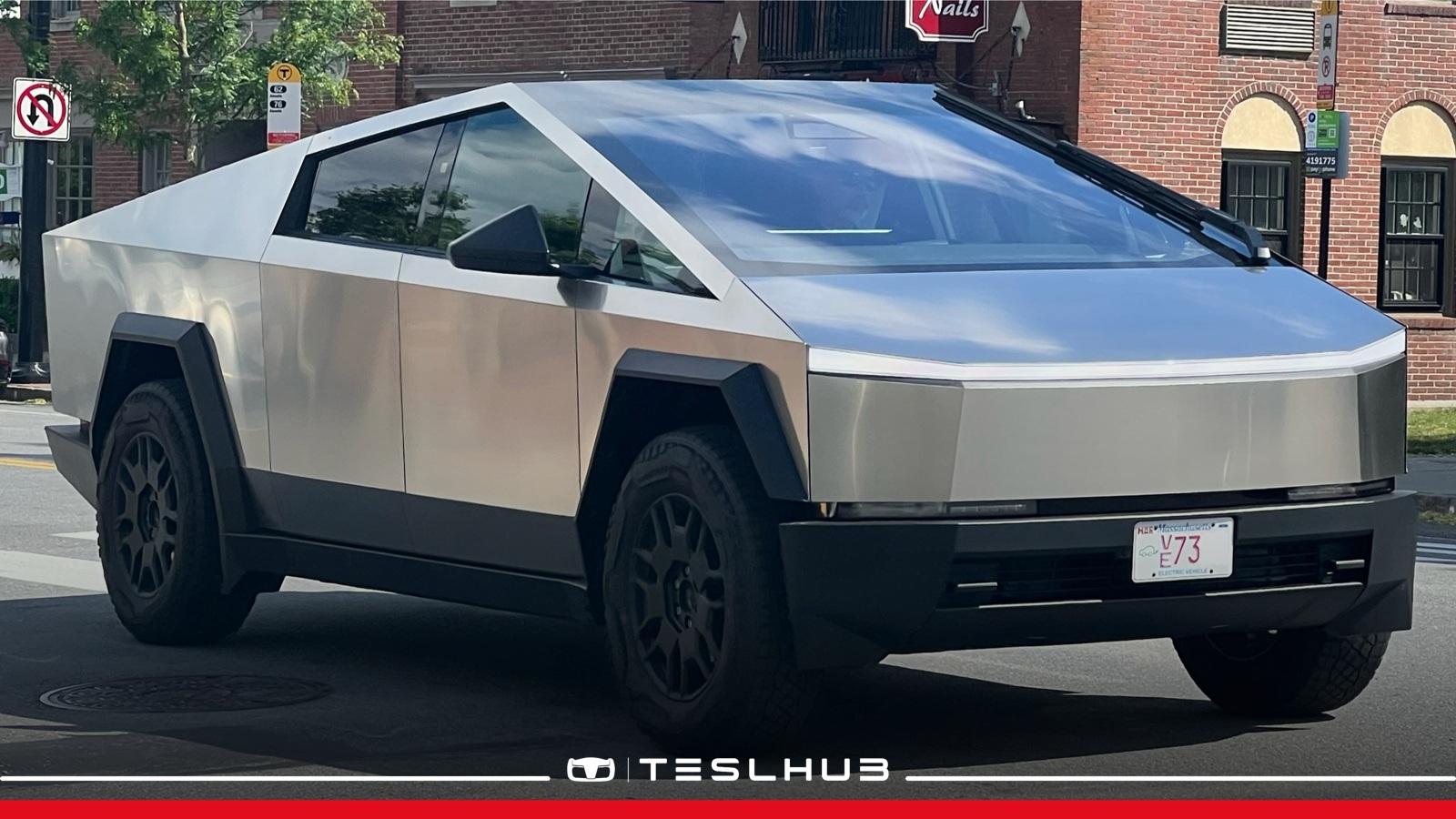
Cover: S5A-0043 / Wikimedia Commons, CC BY 4.0. Archive photograph from 12 June 2024. Cropped and overlaid with Teslhub graphics; no endorsement by the author is implied.




Let’s discuss it
Experiences, questions and perspectives from the Teslhub community.
Please keep the discussion respectful. Members’ comments are moderated before publication.
Start the conversation. Leave the first comment.