
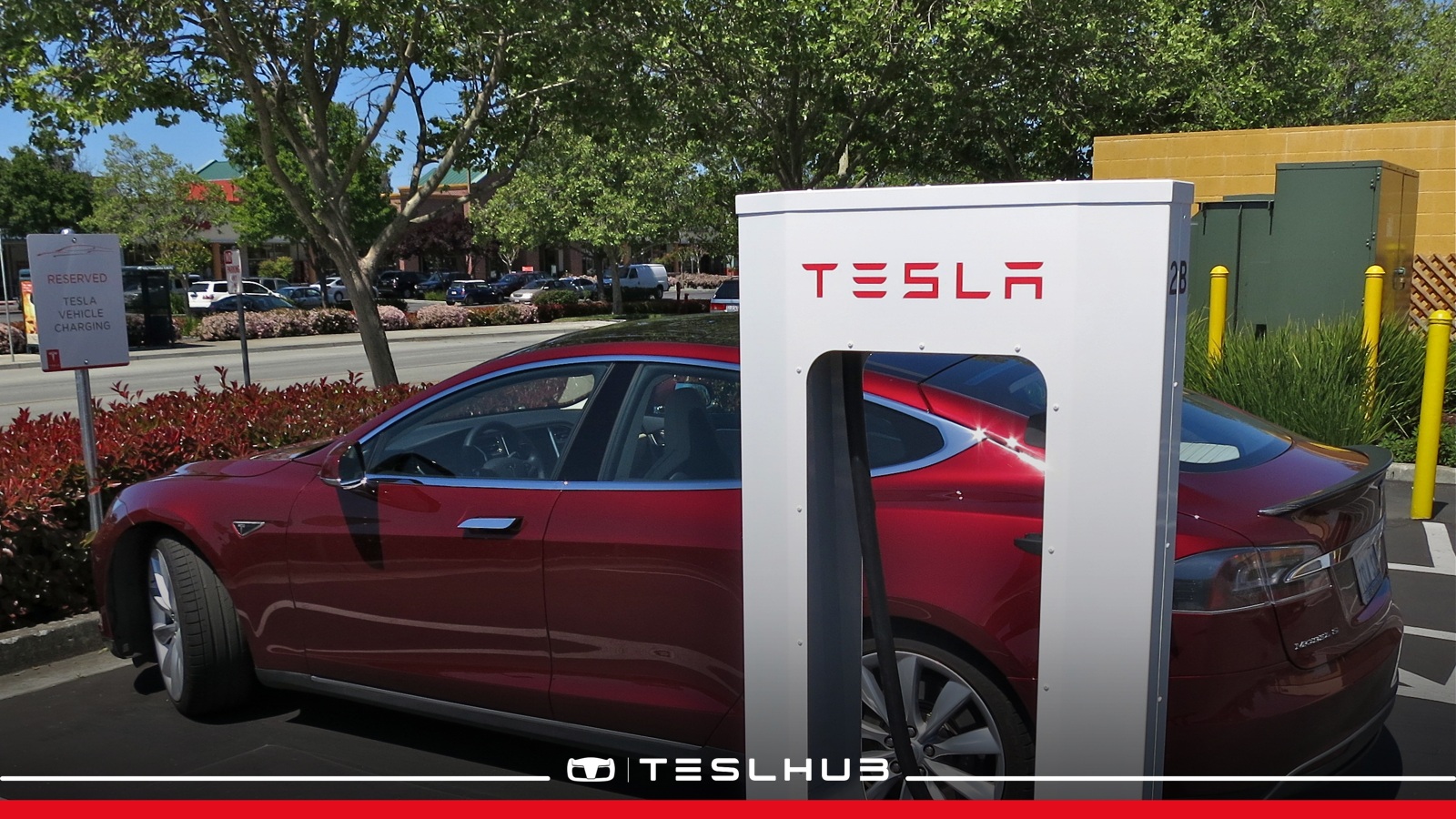
Supercharger: news from 24 September 2012, United States. This archive article was prepared in October 2026. Announcements, performance claims and commercial terms are those of the time, not current offers. The archive cover photograph was taken in Gilroy in April 2013.
Superchargers were created to answer a practical question: what happens when a journey exceeds the car’s range? On 24 September 2012 in Hawthorne, Tesla presented its fast-charging network alongside the first six California locations. Model S deliveries had begun only a few months earlier.
The idea shifted attention from an individual battery to the complete journey. Starting with enough energy for many miles was not sufficient; drivers also needed a reasonable way to continue, integrating charging into stops along the route.
Supercharger: six locations to begin
The presentation concerned six California stations designed to enable longer routes in the region and towards parts of Nevada and Arizona. This was not already a complete national network. Expansion along major US corridors and the start of installations in Europe and Asia in the second half of 2013 were plans announced for the future.
This distinction remains useful today: an expansion map describes an intention, while a usable station is an operational result. Here we recall the presentation, without attributing coverage achieved in later years to the launch evening.
The charging stop becomes part of the journey’s design
The initial announcement described power approaching 100 kW, with the possibility of reaching 120 kW in future. For the 85 kWh Model S, the indicative reference was around half an hour to recover 150 miles of range, or about 241 kilometres.
That figure was a performance claim in the launch context, not a guaranteed time for any session. The idea was to make charging coincide with a break: something to eat or a coffee while the car recovered energy.
Choosing locations near restaurants and shopping centres made that thinking visible. The charger was one part of the experience; the other was the place where drivers would spend the wait.
The network works together with Model S
Access required a combination of hardware, software and service. Direct current reached the battery while bypassing the onboard charger; software managed communication and charging information. Model S update 1.15.8 included components to enable network access.
At launch, Supercharger hardware was standard on the 85 kWh version and optional on the 60 kWh. Tesla also presented charging as free for owners eligible under those terms. This was not a universal rule extending to every Tesla, every market or current commercial conditions.
As a product decision, the integration had a specific meaning: the car’s usefulness beyond the city also depended on things outside the car itself. Building the vehicle and building places to charge it became parts of the same project.
Infrastructure changes the question about range
The arrival of Superchargers did not remove the need to plan. However, it introduced a different way of thinking: alongside asking how far one charge could take you, it became possible to ask where to stop in order to continue.
That is the historical value of the 2012 presentation. Six locations were a limited beginning, but they made tangible the idea of supporting the car on longer journeys. When choosing an electric car, do you place more weight on single-charge range or the quality of available stops along the route?
Sources: Tesla Motors’ release of 24 September 2012; Tesla, 2012 Model S 1.15.8 software notes.
Archive cover photograph: Steve Jurvetson, Model S charging in Gilroy, 18 April 2013, CC BY 2.0. It does not depict the launch evening. Adaptations: cropping and overlaying the complete original Teslhub PNG. No endorsement by the author is implied.


Let’s discuss it
Experiences, questions and perspectives from the Teslhub community.
Please keep the discussion respectful. Members’ comments are moderated before publication.
Start the conversation. Leave the first comment.