
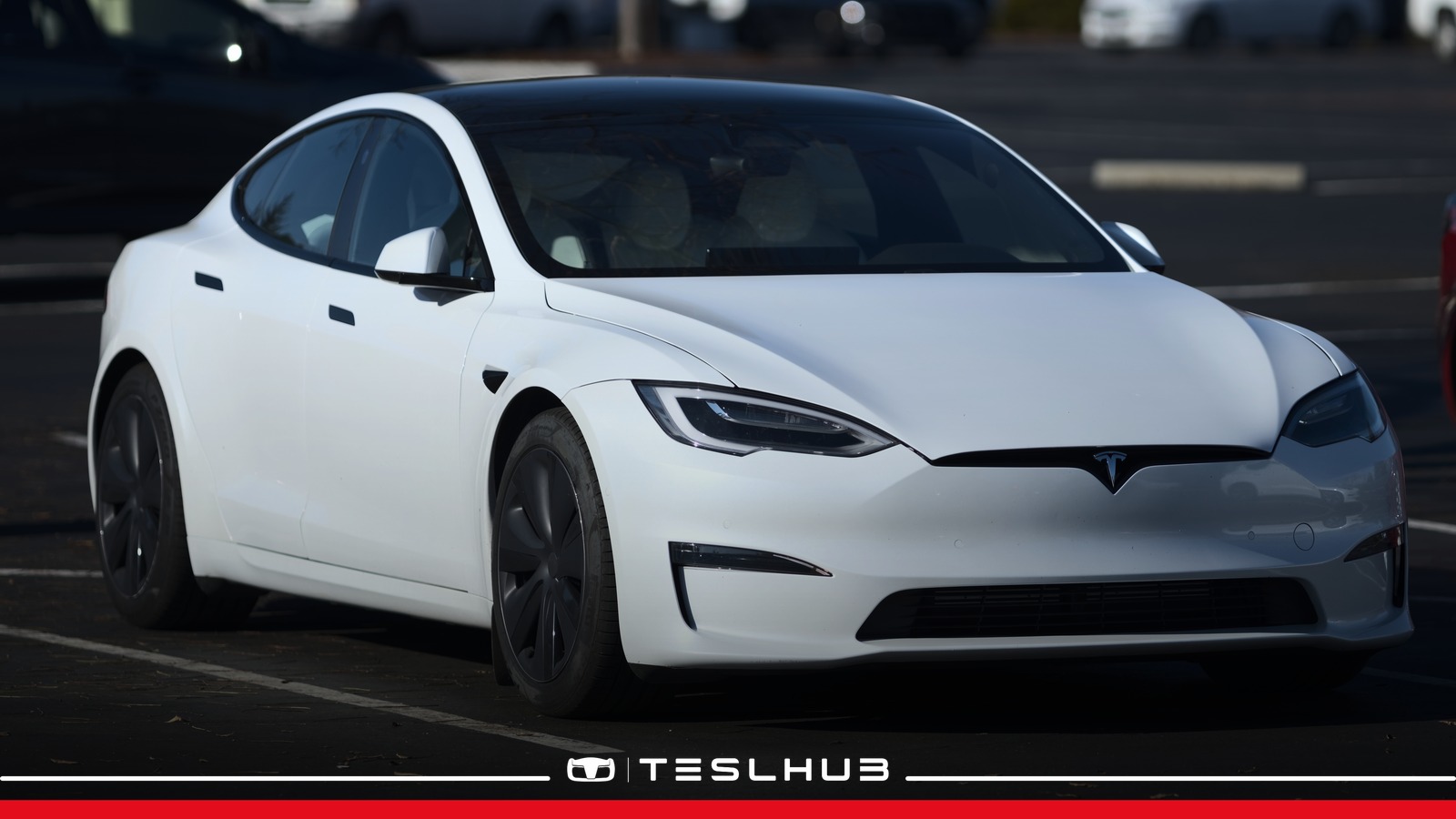
Model S Long Range from the generation introduced in 2021, photographed in December 2022; this is not an image of the Euro NCAP tests. Dllu · CC BY-SA 4.0 · Photograph cropped and combined with Teslhub graphics.
Archive article written on 4 November 2026.
Model S returned to Euro NCAP testing in November 2022 as a substantially revised car. It again achieved five stars, but comparisons with its earlier result needed care: both the vehicle and the assessment protocol had changed.
Protection and driver assistance
The assessment published on 16 November awarded the saloon 94% for adult occupant protection, 91% for child occupant protection, 85% for vulnerable road users and 98% for safety assistance. Those percentages describe different assessment areas; they are not survival probabilities or guarantees that a collision cannot happen.
Tesla highlighted features including an airbag between the front seats, intended to reduce contact between occupants in a side impact, and post-collision braking, designed to reduce the risk of subsequent impacts. Safety therefore included protection during a crash as well as interventions before and after it.
Why the 2014 result is not a direct comparison
The original Model S’s five stars in 2014 came from a different testing cycle. In 2022, Euro NCAP assessed the newer generation under its 2020–2022 protocol, with updated requirements. Achieving the same number of stars did not mean the two assessments were identical.
The high safety-assistance score also needs to be understood within its scope. It assessed functions and test scenarios; it did not approve unsupervised driving or transfer the driver’s responsibility to the car.
For someone considering a used Model S, that distinction makes the result more useful. The individual car’s year, configuration and equipment matter alongside the badge. A historical result helps explain a model’s development without becoming a label that applies equally to every example.




Let’s discuss it
Experiences, questions and perspectives from the Teslhub community.
Please keep the discussion respectful. Members’ comments are moderated before publication.
Start the conversation. Leave the first comment.