
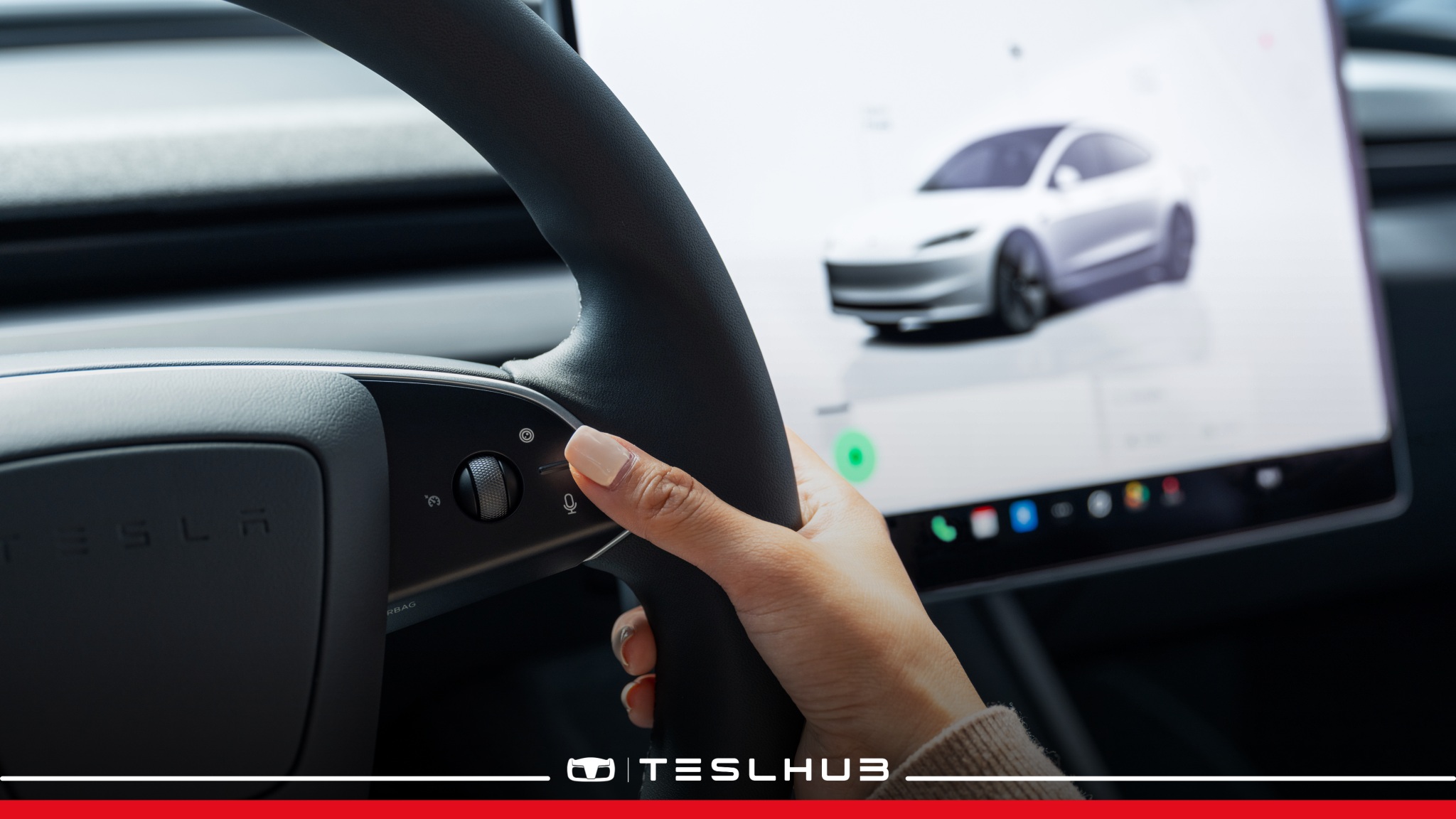
Courtesy of Tesla, Inc.
For people waiting for Tesla’s driver-assistance system in Italy, today’s statement from the Dutch authority RDW deserves a careful reading. The approved changes concern practical aspects of the driving experience: the speed offset, startup settings and the name displayed in the car. The process of extending authorisation across the European Union, however, remains open.
That is the distinction at the heart of the announcement dated 3 November 2026. Tesla can proceed with the changes assessed by RDW under the existing type approval. For Italian owners, this is not yet an activation date, but it is an important update on the system and the conditions under which it is approved.
What RDW has approved
The assessment followed a request from Tesla, which submitted changes to its FSD Supervised system, now referred to as Tesla Assisted Driving, or TAD. RDW examined the changes and incorporated them into the approval already granted, without changing its conditions or scope of use.
During the assessment, the authority checked both implementation of the changes and the car’s behaviour. It found no negative or unintended effects on the system’s operation or the vehicle’s driving behaviour. That assessment concerns the changes examined: it should not be turned into a promise that the assistance can handle every situation without errors or driver intervention.
The outcome therefore preserves the existing approval, incorporating the changes described in the statement. It is not a new authorisation that, by itself, extends the service to every European country.
The speed offset falls from +50% to +10%
The most visible change concerns the percentage offset a driver can select relative to the applicable speed limit. The maximum falls from +50% to +10%. RDW describes this offset as allowing the system to deviate from the limit when necessary for safety and traffic flow.
To illustrate the difference mathematically, 10% of a 100 km/h limit is 10 km/h, while 50% is 50 km/h. This is an example of how the offset is calculated, not a statement of the speed the car will actually travel on that road: its behaviour depends on the system and driving conditions.
Above all, a software setting should not be interpreted as an enforcement tolerance or permission to exceed speed limits. Responsibility for obeying road rules remains with the driver. That distinction matters because, taken out of context, “+10%” can become the main message of the story, obscuring how the assistance works and where its limits lie.
The offset resets to zero at every startup
The lower maximum is not the only speed-related change. Every time the car starts, the offset will return to 0%. A positive value selected previously will therefore not automatically remain set for the next journey.
RDW also says that other speed-related functions will be disabled by default. Its statement does not list those functions in detail: attributing the change to particular menu controls or modes now would go beyond what has been announced.
For users, the practical point will be to understand which settings are actually available after the update and check them at the start of a journey. Resetting to zero is a startup condition; it does not replace the attention needed throughout the drive.
Tesla Assisted Driving appears on the display and in the manual
The new name will appear on the vehicle’s screen, in the manual and in other information provided to drivers. The update therefore brings the Tesla Assisted Driving name into the user experience, beyond the discussions and announcements about the rebranding.
RDW is explicit on this point: the name change does not change how the system works. It remains driver assistance, with the driver responsible. The new name does not introduce an autonomous mode or transfer responsibility for the journey to the car.
That clarification also matters when watching social-media videos. A car performing many manoeuvres with assistance enabled can look as though it is doing everything itself; the person behind the wheel remains an essential part of the conditions of use.
Which cars are affected, and how the update will arrive
The stated scope covers Tesla models equipped with Tesla Assisted Driving and HW4 or later hardware. The changes will arrive through an over-the-air software update, distributed remotely by Tesla.
The statement does not give a software version number, a single release date or a country-by-country schedule. Approval of the changes and their distribution to vehicles are separate steps: it would be incorrect to infer that all affected cars have already received the software.
The hardware requirement must also be read in the context of the system and authorised markets. Having HW4 does not, on its own, mean that all the described functions can be activated in Italy today. Nor does this announcement provide a basis for promises about a release or hardware upgrade for HW3 cars.
Why the European process still matters for Italy
RDW says it has informed the countries that accepted the type approval: Belgium, Croatia, the Czech Republic, Denmark, Estonia, Latvia, Lithuania, Slovakia and Slovenia. Italy is not on that list.
Meanwhile, the process for approval throughout the European Union continues within the TCMV, the European Technical Committee on Motor Vehicles. RDW states that the information shared and discussions held there are confidential, and it does not comment on their contents.
This leaves a clear distinction between what is known and what still needs to happen. We know the changes passed the Dutch assessment and that the existing type approval remains valid. This statement does not give us a final outcome of the European process or an activation date for Italy. Even the most optimistic interpretations circulating on X cannot substitute for an official announcement on those steps.
The issue connects with the Italian political support discussed in our article on Salvini, Musk and Tesla Assisted Driving. Political support, technical approval and availability on vehicles are different matters: following them separately helps explain where things actually stand.
Responsibility remains with the driver
Throughout this process, supervision remains fundamental. Tesla Assisted Driving supports the person behind the wheel, who must continue watching the road and be ready to intervene. Approval of these changes does not alter that relationship between assistance and driver.
For those waiting for the system in Italy, the next things to look for are an official authorisation step and Tesla’s release information for the Italian market. Today’s announcement explains how some settings will change on the affected cars; the Italian timetable remains an open question.


Let’s discuss it
Experiences, questions and perspectives from the Teslhub community.
Please keep the discussion respectful. Members’ comments are moderated before publication.
Start the conversation. Leave the first comment.