
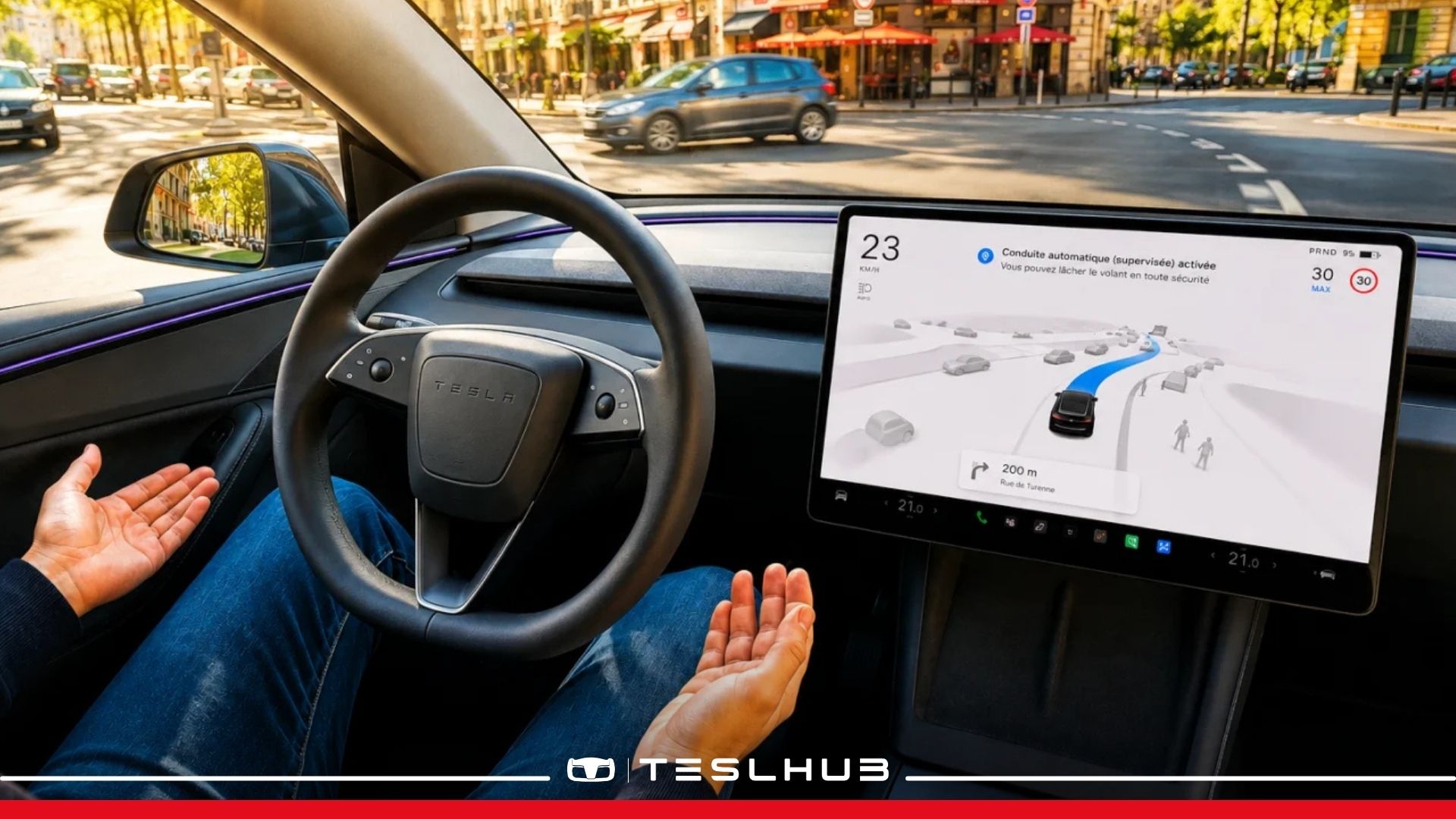
Tesla published an Evidence Dashboard to support its European FSD Supervised approval case. This September 2026 article discussed the company’s safety figures ahead of a possible EU vote reported for 6 October. The figures were manufacturer analyses, not a completed vote or a universal independent measurement of driving risk.
The headline comparison cited about 100 million European public-road kilometres and a 4.1-fold lower collision rate with supervised assistance than the stated manual-driving comparison. Expressed as 1 minus 1/4.1, that is roughly a 76% relative reduction. It does not mean an individual driver’s collision probability is guaranteed to fall by 76%, or that the vehicle can drive safely without supervision.
The article also discussed a broader roughly 3-billion-kilometre 2025 dataset and reported major-collision reductions of 45% on highways, 69% on major roads, 50% in urban settings and 40% on local roads. The dashboard contains different regions, control types and study populations; these figures must not all be presented as one matched European experiment. Definitions, exposure and confidence intervals matter.
Emergency-braking and lane-change measures

The report cited up to 84% fewer automatic emergency-braking activations and 81% fewer harsh-braking events in the stated comparisons. Such surrogate measures are not interchangeable with injury or collision risk: fewer interventions can have different explanations and must be read with the study definitions.
For lane changes, it gave reductions in minor collisions of 99% on highways and 93% off highways, based on 377 million analysed manoeuvres. The event definition, road mix and control groups are essential to interpreting those percentages; they do not establish that every lane change is safe.
A further reported figure was 67% fewer highway driver-fatigue events. That concerned the defined monitoring measure and population, not permission to drive while tired or look away.
The European development fleet

The article described around 1.6 million development kilometres in eight European countries without a major or minor collision attributed to system performance. Attribution to the system is narrower than saying no collision of any kind occurred, and a finite test record does not prove zero future risk.
It also cited more than 230,000 structured scenarios across six European cities, including Rome, with an aggregate pass rate near 98–99%. Structured tests add information, but their results depend on scenario selection and scoring; a pass rate is not a general probability of safe driving in all traffic.
Approvals and continued oversight

The report listed the Netherlands, Denmark, Belgium, Estonia and Lithuania as allowing FSD Supervised under relevant permissions. Each country’s scope and effective date needed its own verification. It also cited more than 3,000 RDW test hours and 1.8 million European kilometres; those figures concerned a different stated test basis from the 1.6-million-kilometre development claim above.
The RDW’s central distinction was clear: the system was driver assistance, not an autonomous car, and the driver remained responsible. The article additionally described more frequent post-approval data collection. Its exact cadence required the relevant monitoring terms rather than assumption from a press summary.
The proposed wider European decision
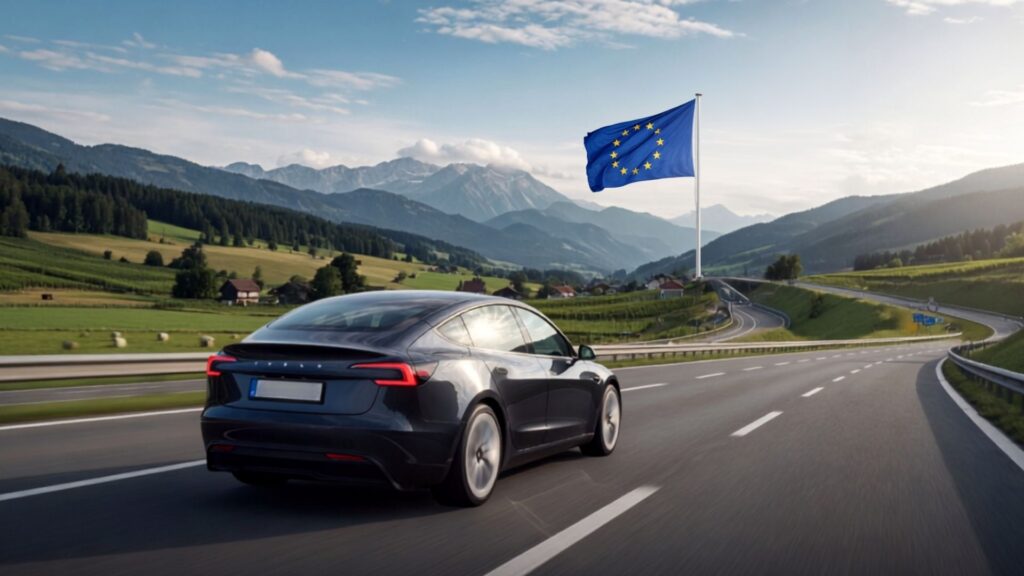
Broader EU validity required the applicable Commission and member-state procedure. Dutch permission alone was not an automatic authorisation for every country.
Tesla’s dashboard made its evidence and arguments more accessible for scrutiny. It did not replace independent regulatory assessment, and the particular exemptions sought required consideration of the complete safety case.
The 6 October date was a possible future milestone in this 11 September account, not a confirmed outcome. Even a favourable vote would still need to be connected with the approved configuration, eligible vehicles and an actual market rollout before promising availability to Italian owners.
💶 REFERRAL PROGRAM 🚘
The referral offer described at publication: €500 off a new Tesla. This is a historical offer, subject to the terms applicable at the time.
Follow the referral link and complete the normal vehicle-ordering process. If the link does not open, copy it into your browser. Eligibility and benefits depend on the terms available when ordering.
https://www.Teslhub.com/Vantaggio
👏 Under the offer described at publication, eligible orders could receive €500 off a new Tesla.
The referral link was also available in our profile under “Buy a Tesla” and in the website menu. Check the applicable offer and terms before ordering.
🌐 STAY UP TO DATE 📢
Follow these channels to keep up with the latest news.
Join Teslhub Members, our Telegram community, to chat, ask questions and share Tesla experiences with us and other members. You can also find us on WhatsApp!
We look forward to seeing you in the next article or on our social channels.
See you soon!
Giorgio Rebecchi
Editor


Let’s discuss it
Experiences, questions and perspectives from the Teslhub community.
Please keep the discussion respectful. Members’ comments are moderated before publication.
Start the conversation. Leave the first comment.